Friday, October 17, 2014

Style Essentials--Femme Fatale Rita Hayworth Puts the Blame in 1946's GILDA


Happy birthday, Rita Hayworth!  Today would have been the 96th birthday of the "Love Goddess," so I celebrate by sharing what is perhaps her best known and beloved film--Gilda (1946).  The costume design alone is iconic and due to Columbia's head designer Jean Louis, who also has a birthday this month.  I recently shared that I will be writing Jean Louis' authorized biography and Gilda is certainly one of the highlights of his career.  This article was originally written back in 2011, but I have updated it with new information, insights, and images.  Cheers to Rita Hayworth and Jean Louis!

----------

There are some movies that are so sexy and sizzle no matter how often you see them, and the 1946 classic Gilda is definitely one. Charles Vidor's film noir is set in Argentina around the end of World War II, and centers on a woman with a past who is caught in a love triangle with a gambler who has been her lover (Glenn Ford) and his boss who has become her husband (George Macready). Film noir is a genre filled with many favorites, but the characters in Gilda are so taut with tension and visuals so rich that there's something exceptional to experience each and every time.  Let's start with the obvious reason why:  Rita Hayworth.  Rita was--and still is--a woman who makes mere mortals swoon and this role of a femme fatale seems custom-made for her.  Though she had crept into our consciousness in Howard Hawks' Only Angels Have Wings (1939) and established her dancing in movies like You Were Never Lovelier (1942) with Fred Astaire and Cover Girl (1944) with Gene Kelly, it was Gilda that secured Rita's star in the heavens.

Rita was always talented, but it took some confidence-building and other changes over the years to bring out what was naturally in her genes. Born Margarita Cansino, her mother Volga was a Ziegfeld Girl and her father Eduardo owned a dancing studio where he taught the likes of James Cagney and Jean Harlow.  Though Rita danced and performed in public with her father from a very early age, she was not immediately loved on screen.  In fact, she was so lackluster that 20th Century Fox, her first studio, decided to drop her after only a few pictures.  Her first husband Eddie Judson (there were five, including Orson Welles) encouraged painful electrolysis to change her hairline and hair color to change her image.  And change it did--that long red hair soon became a signature, in a style that seems influenced by Veronica Lake before her.  Thus "Margarita Cansino" came back as "Rita Hayworth" and was signed to a contract with Columbia Pictures.

There were several planets in alignment with the making of Gilda and its team could not have been stronger.  Two of its great talents were the cinematographer Rudolph Maté and costume designer Jean Louis.  These men more than any other are what allowed Rita to shine so bright. Rudolph Maté is a star in his own right, known for his lush and beautiful cinematography both in and out of film noir.  The look of Alfred Hitchcock's Foreign Correspondent (1940), Orson Welles' The Lady from Shanghai (1947, starring Rita), and Ernst Lubitsch's To Be or Not to Be (1942) are also due to his work.  He even directed some of the best in film noir, including the classic D.O.A. (1950).  There is a depth to Maté's black and white that is unmatched by most in film, and for this reason he is one of my favorite cinematographers.  Interestingly, he was behind the camera for Rita's screen test at Columbia and was largely responsible for head Harry Cohn seeing her potential.  And of course he was a perfect partner on Gilda with director Vidor, whose unique and often intimate framing seems a precursor to later movies like A Place in the Sun (1951).


But perhaps the greatest contributions of all came from Columbia's head costume designer Jean Louis.  Louis is responsible for some of the most stunning wardrobes on film, including for the studio's biggest stars Rita Hayworth, Kim Novak (Bell, Book and Candle), and Judy Holliday (Born Yesterday) as well as  Doris Day (Pillow Talk) and Lana Turner (Imitation of Life) once he moved on to Universal.  He is also famous for designs he did off screen, such as the nude illusion gown he made for Marilyn Monroe when she sang "Happy Birthday, Mr. President" at Madison Square Garden. Like many costume designers, he began his career in fashion and worked at two of the best couturiers in the world--Agnes-Drecoll in Paris and then Hattie Carnegie in New York.  He would also close his career in fashion with a successful line of his own, which was sold through his Beverly Hills boutique and better department stores.  But it is his career in film that has become legendary with one celebrated design after another.  Like costumers Kalloch and mentor Travis Banton before him, Louis brought an elegance to Columbia that elevated the studio's image from its origins as "Poverty Row."  Even in the fabric-rationed years of World War II, you could count on Jean's costumes to be glamorous.

Gilda is known for its glamour and one of the greatest movie wardrobes of all time.  Rita was growing in popularity with the public, and the studio invested thousands of dollars in clothes alone to dress its "Love Goddess" for this film; two or her furs alone cost $100,000.  Though her 29 costumes included smart tailored suits that were de rigueur for the 1940s, the film is best known for its gorgeous gowns.  One, in particular, is iconic--the strapless black satin number she wears to striptease while singing "Put the Blame on Mame."  With design inspired by John Singer Sargent's famous painting Madame X, Louis captured the mood and mystery of the portrait for the character of Gilda.  Audiences were in absolute awe because it seemed to defy gravity; no matter how much Rita moved in her dance, the dress did not.  The gown was a marvel of engineering in addition to its beauty.  As Jean recalled,

It was the most famous dress I ever made....Inside there was a harness like you put on a horse. We put grosgrain under the bust with darts and three stays--one in the centre, two on the sides.  Then we moulded plastic softened over a gas flame and shaped around the top of the dress.  No matter how she moved, the dress did not fall down.

With this costume, as well as others in the movie, Jean did what all great costume designers do--he made the star look her absolute best.  It may seem hard to believe, but even Rita Hayworth had her flaws. "Rita had a good body. It wasn't difficult to dress her," Louis said. "She was very thin-limbed--the legs were thin, the arms long and thin, and she had beautiful hands.  But the body was thick.  She also had a belly then [due to a recent pregnancy], but we could hide that." To do so, Louis included a faux side tie in her "Mame" gown that helped conceal her mid-section. Another gown in the film has ruching around the middle that offers much the same effect.  Several gowns through the movie bare her shoulders, which acts to draw the audience's eye upward.  Still other dresses were accessorized with wide belts that helped define her waist.  And of course everything was done to make sure each was fit to perfection to flatter Rita's 5'6" figure.

One must also remember that the Hays Code was very much in effect during this time and costume designers were restricted in many ways. Nothing could hint at nudity, and those enforcing the production code could censor any costumes they found too suggestive or revealing. Cleavage (or even the shadow of it) was objectionable as was the sight of a woman's belly button.  Yet, even with the Code attempting to dictate design, Jean's gowns are still sublimely sensual.  The "Amado Mio" gown is a perfect illustration of him working around the Code.  The two-piece design is backless and bares much of her midriff (without exposing her navel, of course), yet its long sleeves and floor length make her seem much more covered than she really is.  Also, like the gown for "Mame," Louis included high side slits that are largely hidden until Rita dances.  Only then do they reveal and highlight her lovely long legs.

Gilda is one of The Style Essentials on GlamAmor for the influence of its costume design--both then and now.  In the 1930s and 1940s, films were at the forefront of fashion.  Because of the production process, films were generally made a year or so before their release.  Thus, costume designers had to be ahead of trends and often set them once the movie premiered; for decades, they largely determined how women dressed.  Rita's strapless "Mame" gown captured the imagination of audiences at the time and the design's popularity would continue well into the 1950s.  Though Travis Banton had created a strapless gown for film two years earlier, it was Louis' look in Gilda that inspired the trend. In fact, the Gilda gown is so iconic that it continues to inspire fashion today.  You would be hard-pressed to find an awards show red carpet that doesn't have at least one dress that owes some of its design to Jean Louis.

With so many talents all coming together to create the character of Gilda--Charles Vidor, Rudolph Maté, Jean Louis, and of course Rita Hayworth--it's no wonder that the movie became a phenomenon.  As a result, Rita became one of the top glamour girls of the 1940s and beloved by men all over the world.  Co-star Glenn Ford confessed his own affection years later, which explains why their on-screen chemistry was so strong.  But Rita understood all the pieces that had to be put together to make Gilda possible, and believed that precious few had to do with the real (and painfully shy) Margarita Cansino.  She once famously said, "Men fell in love with Gilda, but they wake up with me."  That may be true, but I, for one, don't think that anyone should have been complaining.


One of the best movie introductions in history with just a flip of her hair:  
"Gilda...are you decent?" asks Ballin Mundson (George Macready, above right).
"Me?"


Former lovers Johnny Farrell (Glenn Ford) and Gilda, now Mrs. Ballin Mundson, meet...


...and the scheming begins in a seemingly innocent belted silk chiffon dressing gown


The next gown is not so innocent...
strong 40s shoulders, sequins top to toe, and slinky and sexy as hell


Gilda flaunts her new-found wealth to Johnny--
a 50,000 peso piece of jewelry that she thinks is "cute"


Dancing with a stranger to stir up jealousy...not in her husband, but in Johnny


Vidor constantly shoots Johnny and Gilda as close as can be,
even when they're sitting at a table with Ballin


A zipper's not the only thing that's tricky in Gilda's life...
Ballin could feel the heat of hatred in the evening and warns Gilda not to make a mistake


Gilda, a great believer in luck, tries hers at the casino tables in this goddess gown...
note how the bracelet matches the belt


Incredible draping in this grecian gown with ruching at the waist


Gilda's beaded jacket (over the grecian gown) is as much as a knock-out as her date from the casino


Another grecian-inspired dress as Gilda sings "Put the Blame on Mame" for the first time


Look at the studded belt and matching cuff that go with the cover-up dress--
perfectly on trend for today and suggest Gilda as a warrior in this psychological battle


Vidor shoots Ballin in interesting ways throughout the movie--often without his head showing (above)
or fully dark in silhouette that speaks to the ominous threat he imposes


Gilda getting ready to don her costume for carnival


Even Ballin points out that Gilda is "armed" with her whip,
ever ready for battle with Johnny even in costume


Johnny is tortured both by Ballin's orders to take care of Gilda
and Gilda making mischief with every man she meets


The energy and anticipation from carnival is too much for the former lovers...


...and they find themselves locked in a kiss
(notice how Vidor keeps the wedding ring front and center in the shot)


Ballin bursts in on the couple and runs for a plane that crashes into the sea


With Ballin's death, the couple is now free to marry


The choice of a black satin suit is an interesting choice and foreshadows what's to come...
still angry at Gilda, Johnny has set a trap that she cannot free herself from


Once trapped to live a loveless existence, Gilda tries to turn to others...
going out night after night in several strapless gowns


Gilda runs to Montevideo to try and escape,
signing on as a showgirl performing "Amado Mio"in a two-piece (and backless) white beaded gown


Gilda mistakenly tries to trust another man, who ends up bringing her right back to Johnny


In a classic 40s pinstripe suit to fight with Johnny Farrell


At her desperate breaking point, Gilda performs "Put the Blame on Mame" again
in Jean Louis' iconic black strapless satin gown that seems to defy gravity


Feeling like a kept whore,
Gilda performs her version of a striptease to show the world what she's become


After such an exhibition, Johnny and Gilda finally come together and speak heart to heart,
but someone sinister appears in the midst of it all...Ballin


After a final fight at the casino, the lovers are left in peace


Additional Sources 

"Jean Louis." People magazine. 9 February 1987: 76. Print. Accessed at Margaret Herrick Library (AMPAS) 16 April 2015.

"Jean Louis." The Times (London). 26 April 1997: unknown. Print.  Accessed at Margaret Herrick Library (AMPAS). 16 April 2015. 

Leaming, Barbara.  If This Was Happiness: A Biography of Rita Hayworth.  New York: Viking Penguin, 1989.  Print.

Modern Screen. January - June 1946: 8. Print. Accessed at Margaret Herrick Library (AMPAS) 16 April 2015.

Stack, Rosemarie. "Natural Elegance." Movieline. 25 July 1986: unknown. Accessed at Margaret Herrick Library (AMPAS) 16 April 2015.

Also

Independent.co.uk

FilmReference.com

Photos

All screen captures by Kimberly Truhler for GlamAmor

Tuesday, October 7, 2014

Cinema Style - All About Costume Designer Jean Louis


UPDATE: Sometimes life just takes you in a different direction. As of July 2019, publisher GoodKnight Books invited me to write Film Noir Style: The Killer 1940s. Thankfully I was able to use all the research I did for Jean Louis' biography in this new book instead. He appears three times - for Gilda (1946), Dead Reckoning (1947), and The Lady from Shanghai (1948). I hope you'll enjoy it!

---

This week we celebrated the birthday of legendary costume designer Jean Louis and I am thrilled to announce that I have been invited by his family to write his authorized biography.

For the past few years, it has been my great pleasure to get to know the family of Jean and Loretta Young (they were married late in life) and am proud to now call them friends.  They respect my commitment to shining a light on the work of costume designers from the Golden Age of Hollywood and know of my deep affection for Jean.  As a result, they have asked me to preserve Jean's legacy by writing the first biography on his life and career.  I will be given their full cooperation on the project and unrestricted access to his photos, sketches, and more.  I am honored to do so as Jean is one of the greatest designers of all time and responsible for some of the most iconic costumes in film.  Countless designers--both in film and fashion--have been influenced by Jean Louis, yet far too few even know his name.  Obviously, I plan to right that wrong.

Many know that I am deep into writing my first book--THE STYLE ESSENTIALS: HISTORY OF FASHION IN FILM 1920s-1980s--and I will continue to do so.  But I began to understand the need to start Jean's biography sooner rather than later due to the number of people who are still with us that I'd like to speak to about his incredible life.  I plan to work on both books together.

If you have some connection Jean Louis and would like to share pictures, personal experiences, or know the location of his designs, please do not hesitate to contact me at Kimberly@GlamAmor.com.

It truly feels like the stars are in alignment because this month we celebrate Jean's birthday (October 5th) as well as one of his great stars Rita Hayworth (October 17th).  For those who would like to watch their films, the recently launched classic film channel getTV is putting the spotlight on Rita this month.  And, because getTV's programming comes from the Columbia library, you can always find films that feature the work of the studio's longtime costume designer.

But first, I offer you this brief illustrated introduction to the great Jean Louis.


From Paris to New York

Jean Louis Berthault was born in 1907 in the style capital of the world--Paris.  There he attended the prestigious École nationale supérieure des Arts Décoratifs (School of Decorative Arts).  After graduation, he started his career in the early 1930s as a sketch artist for the Agnes-Drecoll couturier.  In 1935, he used settlement money from an auto accident to fly to New York City.   While on holiday, he was encouraged by friends to share some of his sketches with the best fashion designers in the city.  It was Hattie Carnegie who saw the greatness of his talent and hired him.

At that time, Hattie Carnegie (real name: Henrietta Kanengeiser, below) was America's reigning fashion queen and beloved coast to coast.  She began as a couturier with hats and custom-made clothing, but in 1928 she prophetically decided to start an affordable ready-to-wear line of clothes for the masses. As a result, her business not only survived the Great Depression, but thrived throughout it.  Every woman wanted to be fashionable no matter what her budget during these challenging years and Hattie Carnegie made this possible.  She was at her height in the 1930s and by the 1940s, her store had grown and had different departments for furs, hats, handbags, jewelry, vintage furniture, china and glass, cosmetics, and perfume.  The brand became known for being able to dress women "hat to hem."  The only thing she didn't sell was shoes.


Hattie never could sew, but she was a great editor and able to spot and cultivate talent.  Many legendary designers trained under her.  Norman Norell was one of the first and became the head of her new ready-to-wear line.  Others who started their careers at Hattie Carnegie include Travis Banton, Pauline Trigere, James Galanos, and Jean Louis.  Interestingly, all of them spent time as costume designers for film.  Even with this incredible collection of talent, Jean was well known among the designers at Hattie Carnegie.  One reason for this was his design of the 'Carnegie suit' in 1937.  Hattie's slogan was that "the woman should wear the clothes, not the clothes wear the woman," and Jean's design for the 'Carnegie suit' perfectly captured this.  It worked for anyone who wore it and allowed for each woman's personal style.  It also transcended the eras--it was as popular in the 1950s as it was when it first came out in the 1930s.


Wallis Simpson, Duchess of Windsor, in the 1930s in what looks to be a Carnegie suit (above)
and the suit still wowing women in the 1950s


At Hattie Carnegie, Jean developed a loyal clientele. This included royal style icon Wallis Simpson, Duchess of Windsor, who frequently wore his designs.  It also included Hollywood royalty, such as Constance Bennett and Joan Crawford.  It was Irene Dunne who bought one of his first designs--a blue satin evening gown--and remained a customer the rest of her life.  Another was Joan Cohn, wife of Columbia president and production director Harry Cohn.  In 1944, she suggested that Harry put Jean under contract at Columbia as an assistant costume designer.  Jean readily accepted the position, especially because it allowed him to work again with his mentor and former Carnegie colleague Travis Banton. Banton briefly worked at Columbia after his time at 20th Century Fox, and taught Jean the distinct differences between designing for life and designing for film.  Jean's first work at Columbia would be for friend Irene Dunne in the appropriately named Together Again (1944).  The film world would never be the same.


The Columbia Years

Once Banton departed for Universal in 1945, Louis was made the head costume designer at Columbia.  He was then given the rare honor of full screen credit for his "Gowns by Jean Louis."  His overarching style was sleek and simple, but very elegant.  Superfluous details never complicated his designs.  It's for these reason that his clothes remain so timeless today.  During his career, he would help establish the style of several actresses.  One of the first at Columbia was Rita Hayworth, who he worked with in 1945's Tonight and Every Night.  But it was their next movie, the the now iconic Gilda (1946), that turned her into an international superstar. As that character and in Jean's gowns, Rita became known as the "Love Goddess" all over the world.  Her black satin strapless "Put the Blame on Mame" gown, in particular, is widely considered one of the ten best costumes of all time.  It is also one of the most influential on fashion designers--you would be hard-pressed to find an awards show red carpet today that doesn't have at least one dress that owes some of its design to Gilda.  Jean's next movie with Rita The Lady from Shanghai (1947) was another film noir with a stunning wardrobe for the screen siren.  They would go on to do 10 pictures together.

After Rita decided to depart from Columbia (and then even America so she could marry a prince), the seductive Kim Novak stepped up as the studio's new star.  Jean was with her from the very beginning, even designing a special wardrobe for her screen test at the request of head Harry Cohn.  Bell, Book and Candle (1957) and Pal Joey (1958, with Rita) are just two of the films that Jean and Kim did together, and her clothes reflect both the sweet and sultry sides of her personality.  Both movies were Oscar nominated for their chic costume design along with ones he did for Judy Holliday, who was another star at Columbia.  Louis transformed her into dancer "Billie" Dawn for the Oscar nominated Born Yesterday (1950), a particular triumph as Judy was not naturally glamorous and seemed "completely disinterested" when she was dressed for the costume tests.  Yet onscreen, in Jean's gorgeous clothes, she found the character and "even he was amazed at the changes."  Perhaps it's an especially sweet victory then, after 14 nominations, that Jean finally hit the jackpot with Judy's film Solid Gold Cadillac (1956) and won his one and only Oscar.


Iconic film noir style for Rita Hayworth in Gilda (1946)
and The Lady from Shanghai (1947)


Transforming Judy Holliday for Born Yesterday (1950)
and the Oscar-winning The Solid Gold Cadillac (1956)


Kim Novak in her favorite color purple for Pal Joey (1957)
and ever seductive in Bell, Book and Candle (1958)


The Universal Years and Beyond

In 1958, Jean followed Banton's example once again and went to head the costume design department at Universal. There he immediately met another star who he would help define her signature style--Doris Day.  Pillow Talk (1959) was the first of their films together along with her three-time co-star Rock Hudson.  This marked a turning point for her.  "He created a sophisticated allure for Doris that launched a new phase of her career," wrote journalist Tom Vallance.  With this wardrobe, Jean highlighted her phenomenal figure with colorful tailored wiggle dresses and brought out the sexuality in her virginal onscreen persona.  Friend James Garner--who starred with her in The Thrill of It All (1963, also designed by Jean Louis)--said Doris "exuded sex" while still maintaining her image of the All American Girl.  Pillow Talk is so influential that I have chosen it as one of The Style Essentials and it is one of my personal favorites as well.  It started a look she would continue in subsequent films, no matter what costume designer was assigned to the production.  Irene (Lover Come Back), Morton Haack (Please Don't Eat the Daisies), and Ray Aghayan (Glass Bottom Boat) all followed Jean's lead with her.  Jean would return to work with Doris again on her third picture with Rock Hudson Send Me No Flowers (1964).

Another actress he loved and worked with while at Universal was Lana Turner.  Next to Rita, Lana is perhaps the best example of Jean Louis style.  In an era when costumes were becoming more realistic in film, Jean continued to be known for glamour and frequently designed for Lana.  Costumes in these lavish films--particularly those by producer Ross Hunter, which included Pillow Talk--really showed Jean's gift with color.  It was one of his great talents and something that drew me personally to his designs.  "He had the most amazing discerning eye for color," recalls his daughter-in-law Linda Lewis.  "It was a 6th sense for him."  Another of my favorite movie wardrobes is Jean's colorful confections for Lana in Imitation of Life (1959).

In addition to his time at Universal, he also started to freelance for other studios around 1960 and would continue to do so until 1973.  This included the costume design for blonde bombshell Marilyn Monroe for her last films The Misfits (1960) and the sadly unfinished Something's Got to Give (1962).  But his best known costume for Marilyn--and indeed one of the most iconic of all time--is not from film at all.


Jean Louis helps Doris Day find her signature style in Pillow Talk (1959)
and The Thrill of It All (1963)


Giving Lana Turner glamour in Ross Hunter productions
Imitation of Life (1959, above) and Madame X (1966)


With Marilyn Monroe in her last productions The Misfits (1961)
and the unfinished Something's Got to Give (1962)


Acts of Illusion

Jean was not only known for his glamorous costumes onscreen, but offscreen as well.  He was a genius for creating drama for actresses on the stage.  First, in 1950, he designed Dorothy Lamour's stage costumes at the London Pallidum where a subtle striptease revealed her signature sarong underneath.  But his most famous moment on stage came in 1962 when he literally sewed Marilyn Monroe into a flesh-colored marquisette gown covered in 2,500 graduated rhinestones.  In it she sang "Happy Birthday, Mr. President" to John F. Kennedy at Madison Square Garden in front of 15,000 people.  It is an iconic gown that everyone knows today.

Marilyn's dress was inspired by stage costumes Jean created for Marlene Dietrich and her Las Vegas cabaret act during the 1950s and 1960s.  Much like he did for Rita in the 1940s, Jean first created a body stocking for Marlene that perfected her figure underneath; it is one of the reasons she seemed so age-defying over the years.  He then slipped a gown of nude silk chiffon with strategically placed sequins over the foundation garment.  Because he matched the fabric so closely to the color of her skin, it gave the illusion of her wearing nothing at all.  Eventually, Jean designed an entire wardrobe of these 'illusion gowns' for her act in various colors with sequins or beading.  Her show became so popular that she would tour the world performing in Jean's custom-made costumes.  His gowns for both Marilyn and Marlene have had such a lasting impact that they continue to influence many designers today. 


Marilyn in her iconic "Happy Birthday, Mr. President" gown at Madison Square Garden 1962


Marlene Dietrich in one of her many illusion gowns for her Las Vegas cabaret act during 1950s and 1960s


Lovely Loretta

In addition to film, Jean also contributed to iconic television.  He and his wife Maggie were both great friends with Loretta Young since he designed for her on the Columbia picture Paula (1952).  She then launched The Loretta Young Show in 1953, which was groundbreaking at the time (she was both producer and star) and it became known for its fashion.  Audiences tuned in week after week to see what she was wearing in her entrance and watch her signature 'twirl.'  It is widely reported that Jean created all of her television costumes, but this is simply not true--many designers were involved, including Werlé and Travilla.  Jean would not work with her again until The New Loretta Young Show debuted in 1962, and then he designed all 26 episodes of the series until it ended in 1963 (that time period is reflected in the photo below).


Then, in the late 1960s, Jean would finally step out and design his own fabulous fashion line while continuing to do films freelance at the studios. His label was called "Jean Louis, Inc." and sold through his Beverly Hills boutique as well as better department stores across the country.  Not surprisingly, he was especially popular with sophisticated women in California and New York.   During this decade, he also was responsible for updating the United Airlines uniforms, which made all the attendants look beautiful and set that certain Modern style we still admire today.  Loretta remained one of the best models of his work, though, as you will see in the photos here.  She once said, "I love his clothes because they are understated high fashion and yet seductive at the same time." I couldn't have said it better.

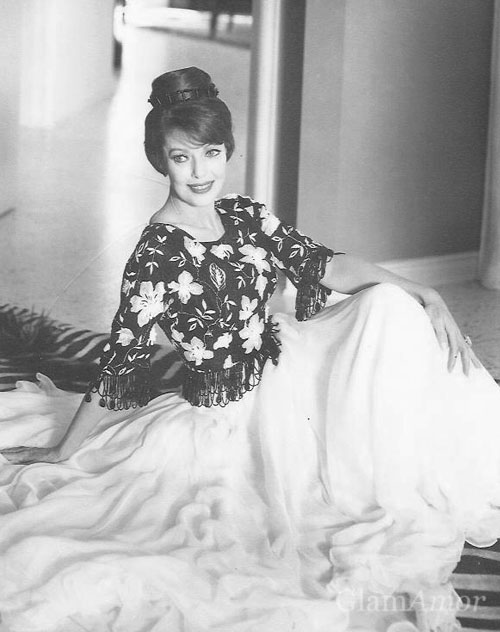
After his dear wife Maggie passed away, Jean and Loretta remained very close and were married toward the end of their lives in 1993.  He was a loyal friend and Linda Lewis described him as "a soft-spoken and quiet man, but with a lovely sense of humor."  He also had great style, which was as important to him personally as it was when dressing his stars.  I frequently speak of the great partnerships between costume designers and actresses from the Golden Age of Hollywood--Adrian and Joan Crawford, Edith Head and Grace Kelly, Helen Rose and Elizabeth Taylor.  Jean Louis and Rita Hayworth should be added to that elite list.  Travis Banton is another with his strong partnership with Marlene Dietrich during her early days at Paramount.  Interestingly Jean, his good friend, would have that kind of relationship with her in the later days of her career.

But obviously, we can't stop there as countless others owe something to Jean.  As we discussed, Kim Novak, Doris Day, Lana Turner, Judy Holliday, and Marilyn Monroe are all examples of his design genius.  We should also include Irene Dunne, Rosalind Russell, Joan Crawford, Judy Garland, Katharine Hepburn, Deborah Kerr, Julie Andrews, Shirley MacLaine, Shirley Jones, Ann-Margret, Gloria Grahame, and Lizabeth Scott.  Just to name a few.  Carol Channing, who he designed for in Thoroughly Modern Millie (1967) said, "Jean loved each one of us....He saw us as perfect as the way God made us."

Though he passed away in 1997, the legacy of Jean Louis lives on and on.  His impact can be found in film as well as fashion--Jean is responsible for multiple examples of iconic costume design and it continues to influence many artists today.  As I share in my Cinema Connection series, fashion designers frequently take inspiration from his work.  Michael Kors, Vera Wang, Zuhair Murad, Giorgio Armani, Georgina Chapman (Marchesa), Sarah Burton (Alexander McQueen), and Zac Posen are some who have paid homage to Jean in their collections.  Another is my friend Ali Rahimi, designer for the Mon Atelier couturier, who cites Jean Louis as a major influence.  Jean's vision has been personally meaningful to me as well.  And, to be sure, many more are inspired by his designs likely without even knowing his name.

I know that this is but a brief introduction to the greatness of Jean Louis and his vast talent, but I look forward to sharing much more with you later when I finish writing the book.

I cannot wait.


Loretta Young in Jean Louis


Jean and Loretta happily married in the 1990s


Many thanks to

Chris and Linda Lewis

Other Sources

Biography.com

DorisDay.net

DorisDayMagic.com

FilmReference.com

Hattie Carnegie--FashionEncyclopedia.com

Hattie Carnegie--OnThisDayinFashion.com

History.com

Holtzman, Will.  Judy Holliday.  New York: G. P. Putnam's Sons, 1982.

Independent.co.uk

JWA.org

Leese, Elizabeth. Costume Design in the Movies.  New York: Dover Publications, 1991.

NYTimes.com

PrettyCleverFilms.com

Shipman, David.  Judy Garland: The Secret Life of an American Legend.  New York: Hyperion, 1992.

TheMarilynMonroeCollection.com

Time.com

VintageFashionGuild.org

Images as noted ©GlamAmor and thanks to Linda Lewis
Related Posts Plugin for WordPress, Blogger...